



 Mar-27-2026
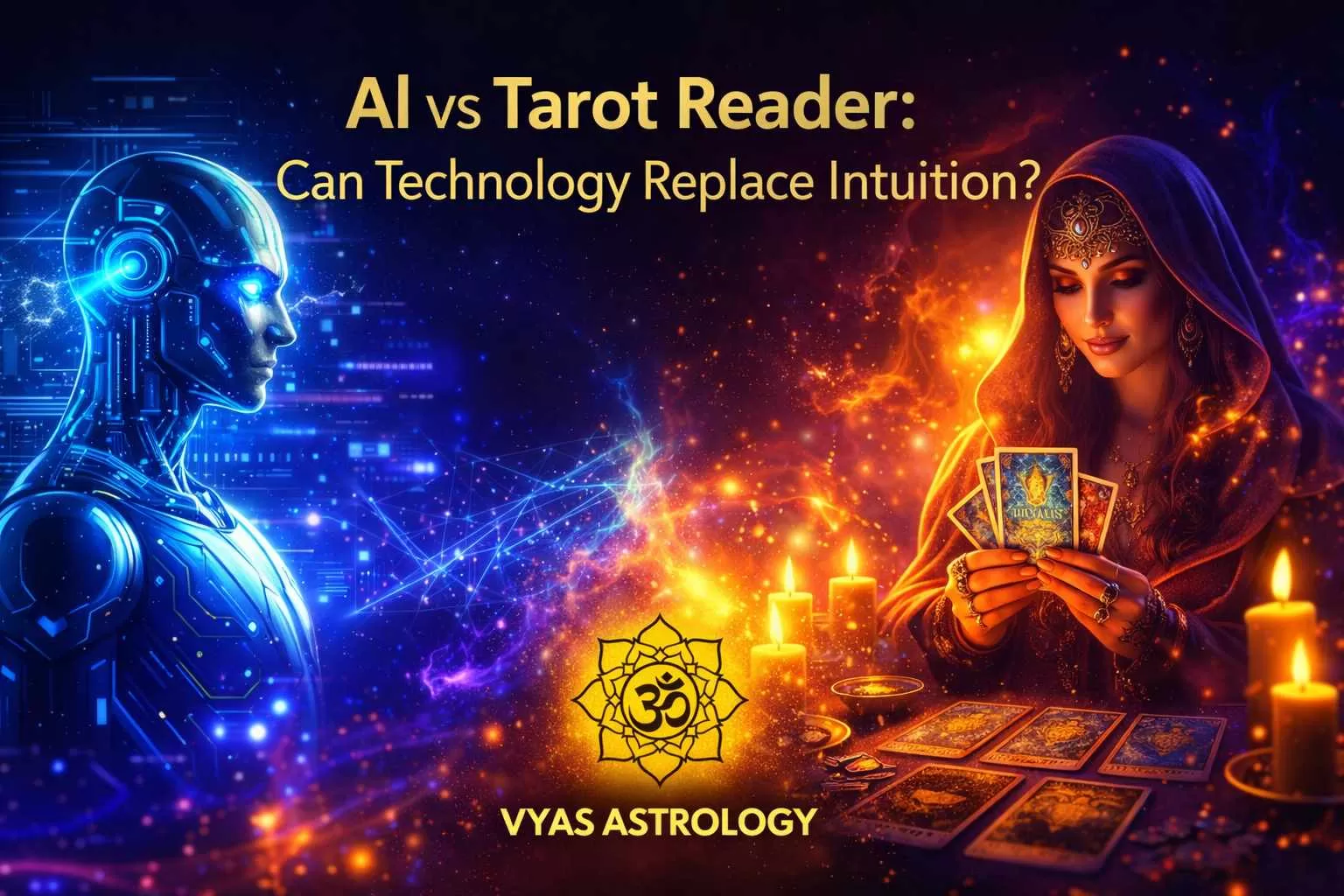
In a day and age where artificial intelligence has a way of writing poetry, diagnosing stocks, forecasting stock markets and even having conversations with humans, there is a strange question that has begun to surface: will AI be able to replace a tarot reader? The comparison seems at first glance to be a weird one, as AI is based on data, logic, and algorithms, whereas tarot reading is linked to intuition, spirituality, and human perception. But each of them boasts of providing guidance, forecasts, and views on life. This leads to a more profound question: is it possible to substitute intuition with technology, or do human beings know more which machines can never know?
Learning Artificial Intelligence and Tarot Reading
Artificial Intelligence or AI is based on the analysis of big data and pattern recognition. It makes decisions based on the previous information and predicts the future or reacts through probability. AI has no feeling or thinking ability; it is a calculation. Regardless of the use of a chatbot to provide relationship advice or an AI-based tech to forecast career success, the responses rely on trends gathered by millions of human experiences in a data format.
On the contrary, Tarot reading is an activity which originates in the 15th century. The tarot readers apply a set of symbolic cards to interpret the past, current and future of a person. Nevertheless, the vast majority of practice tarot readers will explain that it is not really all about remembering the meaning of the cards. It is intuitive, the feeling of emotions, energy, body language, tone, the unspoken feelings. The cards are perceived to be an instrument, and the meaning is done by the intuitive knowledge of the reader.
AI is also data-driven and tarot is also intuitive. This is the essence of the dissimilarity between the two.
The Parallels: Why AI and Tarot are Compared.
Surprisingly, AI and tarot analysis have comparable psychological and social purposes. The two are commonly applied by individuals who need direction or guidance, reassurance or clarity in life. An individual who does not know what they want to do in life may request AI to provide career guidance, and another one may visit a tarot reader and seek guidance regarding their career. In both scenarios, the individual is not merely seeking information- he or she is seeking meaning.
The AI will be able to determine your personality through your writing style, your interests, and your habits, and even your social media behavior. It can recommend what profession would be best to follow, what are the habits you ought to develop or how you ought to foster your relationships. Something similar is done by the tarot readers, only that they do not use data, rather they use symbolic interpretation and intuitive understanding.
In most aspects, both AI and tarot are mirrors. They mirror back to you thoughts of your own in an organized manner. There are other instances where individuals have the solution to their issues but they require an outside voice to make them realize this. In this regard, AI and tarot reading are means of self-reflection.
The Difference: Data vs Intuition.
Intuition is the greatest distinction between AI and tarot reading. Intuition is not a mere guessing, it is a multifaceted human skill that is cultivated basing on experience, emotions, empathy, and unconsciousness of pattern recognition. A human tarot reader has a chance of seeing your facial expression, your indecisive behavior, the tone of your voice, and your emotional response. How you react will make them alter their interpretation. It is a very human interaction.
Even the most advanced AI does not actually perceive emotions, it just understands the trends of language and behavior. It is able to mimic empathy, it lacks empathy. It is able to come up with reassuring phrases, yet it lacks knowledge of agony. This is a significant difference.
To take a case in point, when a client is grieving, heartbroken and confused, a tarot reader may react not only with words, but with no words, intonation, eye contact and feeling. Human presence cannot be imitated by AI. It is capable of responding immediately and yet it is not able to be there with you.
Can AI Replace Tarot Readers?
The answer is complicated. It is already possible to simulate tarot readings with AI. Apps and websites exist in which AI makes tarot card spreads and interpretations automatically. The functioning of these AI-based tarot machines is that they combine traditional meanings of cards with psychological guidance and probabilistic foretelling. AI tarot can serve effectively and be available to the person who needs a quick solution or an entertaining activity.
But this is not the only way of replacing a human tarot reader by giving the meanings of the cards. It is of human connection, trust, empathy and intuition. A large number of people come to tarot readers not only to get predictions, but to have someone to listen to them, know them and emotionally coach them. In this respect, the practice of tarot reading is more related to counseling rather than fortune-telling.
AI will be able to give information and recommendations, but it will not substitute human emotional intelligence. At least, not yet.
The Psychology of Tarot and AI Advice.
Both AI advice and tarot readings are psychologically effective due to the so-called Barnum Effect. It is a psychological phenomenon, in which individuals suppose that general statements have a particular application to them. As an illustration, when a person states, You have gone through hardship in the past, but you are a powerful man, the majority of the people will feel that the words addressed to him or her are personally significant.
The AI and the tarot sometimes implement general patterns and statements that are applicable to large groups of people but the individuals interpret them differently. This does not imply that they are not authentic or useless. As a matter of fact, these tools have the ability to make people reconsider their life in a different perspective.
In a number of situations, it is not in prophesying what will happen that the worth of tarot or AI advice lies, but rather in aiding individuals to evaluate what is happening at the present moment.
The Future: Technology and Intuition Coexist.
Rather than considering AI vs tarot as a competition, it may be better to consider it as a case of two different tools. AI symbolizes reason, information, and processing. Tarot symbolizes intimacy and feeling, as well as human contact. It may not be a competition of one over another but the co-existence of the two.
As an example, AI may process the career choices of a person based on the data, whereas a human guide, counselor, or tarot reader may guide the individual on what she/he desires both emotionally and spiritually. One gives us information, the other meaning.
Technology is able to process information more quickly than a human being, however, a human being perceives life in a more emotional and experiential context. Intuition is based on living, feeling, failing, loving and learning through which machines never go through.
Conclusion
And, therefore, can technology be a substitute of intuition? At least in the short term, the answer is no, whereas AI can simulate human dialogue and analyze behavior and come up with recommendations but intuition is a distinctively human gift that is influenced by emotion, empathy, and experience. Regardless of whether one accepts the mysticism element of tarot reading or not, it is strongly embedded in human intuition and feelings.
In the future, AI can take over a lot of jobs, particularly data and repetition-driven ones. Such areas like those necessitating a human touch, emotional knowledge and intuition will be far more difficult to substitute.
Ultimately, AI and tarot readers are two alternative approaches to interpreting the world, the former one being more data-driven, the latter one being more intuition-driven. It is not the question of which one is better, maybe, but the question of why as humans people continue to seek meaning, direction and assurance even in a world that is so technologically advanced.
Due to the fact that in some cases, one cannot find the right answer, but a worthwhile answer.
Talk to an Expert Astrologer Today - Get your Kundali reading, Vastu consultation, or personalized guidance.
Recent Posts
-
Jun/21/2026
Property Yog In Kundali: मंगल देता है मकान, शुक्र देता है सुख और शनि देता है जमीन
-
Jun/17/2026
धन वृद्धि के उपाय: इन 7 आदतों से दूर हो जाती हैं धन की देवी लक्ष्मी जी
-
Jun/15/2026
वट पूर्णिमा 2026 में कब है? जानें पूजा विधि, महत्व और शुभ योग।
-
Jun/15/2026
अधिक मास 2026: अधिकमास या मलमास किसे कहते हैं? और इसका महत्व क्या है?
-
Jun/15/2026
जून 2026 में पूर्णिमा कब है? जानें ज्येष्ठ पूर्णिमा की सही तारीख
Appointment Booked!
Thank you! We have received your appointment request.
Our team will contact you shortly.
Book an Appointment

Discover your destiny with accurate and trusted astrology guidance by Vyas Astrology.
-

Jangipura, Subhash Ganj, Tiwari Pura, Dabra, Madhya Pradesh 475110.
-

-

Connect with social media:
© 2026 Vyas Astrology. All Right Reserved. Developed By: AIS